Basic HTML Version


Chapter 11
17
PULMONARY BAROTRAUMA
OF DESCENT
(
LUNG SQUEEZE
)
There is a slight risk of pulmonary barotrauma during descent as well as ascent, although
from a different mechanism.
A diver descending during a breath-hold dive will have the air in his chest and lungs
progressively compressed in accordance with Boyle's Law. Eventually a lung volume is
reached when the compression of gas can no longer be accommodated by a further reduction
in lung volume, and is instead compensated by the engorgement of blood vessels in the
lungs. The lung blood vessels have only a limited ability to distend, and can be expected to
rupture once this limit is exceeded, causing pulmonary haemorrhage.
A rapid descent when standard dress equipment is used, or failure of a surface-supply gas
pressure in the absence of an effective non-return valve, are also possible causes of
pulmonary barotrauma of descent. It is theoretically possible whenever a surface-supply of
air is used e.g. standard dress, surface supply from a compressor or compressed air tanks, or
pumping the air supply from the surface in commercial devices.
It is more likely in breath-hold diving, but case reports of this condition are infrequent and
poorly documented. It is more likely in deep, record breaking attempts. The theoretical basis
of the condition was severely tested when a world record descent to beyond 200 metres was
made by a breath-hold diver several years ago.
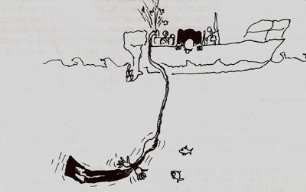
Fig 11.9
SSBA with no non-return valve, when the compressor stops