Basic HTML Version


Chapter 13 — 7
!
Cold.
Diving in cold conditions makes DCS more likely, especially when the diver is inadequately
insulated. More precisely, coldness during the dive inhibits inert gas uptake (because of
restricted circulation) but allows more N
2
to dissolve in body fluids — whilst coldness during
decompression inhibits inert gas release. Theoretically, it may be better to be cold during the
dive and warm on decompression, unless bubble formation occurs. Warming will then reduce
gas solubility and increase bubble growth and DCS.
The association between cold exposure and DCS is complex and contentious. During
decompression and post-diving the cold environment may cause peripheral constriction of
blood vessels and more bubble formation. Alternately, taking hot showers also tends to cause
increased bubble formation and DCS.
!
Alcohol and other drugs
It has been observed that divers who over-indulge in alcohol, or perhaps take
other
drugs
or medications, may be especially susceptible to DCS. In the case of alcohol,
especially taken the night before, the effects may be due to the associated dehydration or the
vascular dilatation (remember the throbbing headache and “hangover”), increasing N
2
take-
up.
!
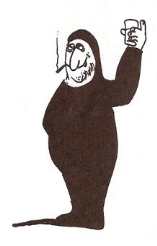
Exercise.
This also is complex and contentious. Some even claim
that exercise 2-24 hours before diving, and even after
diving, may reduce bubble formation. At least in rats.
Strenuous exercise during a dive is likely to increase the
N
2
uptake by increasing blood flow to muscles, increasing
gas uptake and favouring DCS development. Gentle
exercise during decompression, by promoting circulation
from the tissues probably aids in N
2
elimination. The
effects may depend on whether bubbles or bubble nuclei
have already formed. Strenuous exercise after the diver has
returned to the surface makes the development of DCS,
particularly in the musculo-skeletal system, more likely by
promoting bubble formation. Strenuously activity, such as
by shaking a beer can before opening it, aptly illustrates
this phenomenon. During the first hour or two after a dive,
particularly when there has been a large N
2
uptake, it is
probably best to rest quietly as this is the period of
maximal N
2
elimination.
Fig. 13.2
!
. Physical Fitness.
The less physically fit the diver, the more likelihood of DCS, probably because more energy
is used and more blood flow is required for the same outcome – transporting more N
2
.