Basic HTML Version


Chapter 16 — 4
Transportation in aircraft
presents problems. Apart from movement which aggravates
DCS, environmental pressure decreases with altitude, causing DCS bubbles to expand
(Boyle's Law) and more gas to pass from the tissues into any bubbles.
If the patient is evacuated by air, unpressurised aircraft should endeavor to fly at the lowest
safe altitude. Even an altitude of 300 metres (1000 ft.) can make the symptoms of DCS
worse. However, maintaining such an altitude can be alarming when flying over 297 metre
terrain.
It should be remembered that most commercial "
pressurised
" aircraft normally maintain a
cabin pressure of around 2000 metres (6000 ft.), which could seriously aggravate DCS.
Whenever possible the cabin altitude should be maintained at 1ATA. This is attainable by
many modern commercial jet aircraft, executive aircraft such as the King Air and Lear Jet,
and some military transport aircraft (Hercules C–130). This requirement is not popular with
the commercial airlines since it necessitates the aircraft flying at lower than its most efficient
altitude, resulting in excessive fuel consumption. This requirement may also limit the range
of certain aircraft.
Breathing 100% Oxygen before and during the flight may be
of value,
especially
from closed or semi-closed circuit equipment. There are risks to the
aircraft and its inhabitants if open circuit O
2
is used as many airlines
recirculate the cabin atmosphere and fire/explosion is possible.
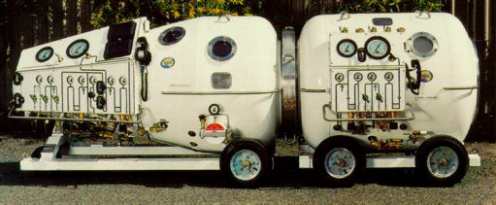
Fig. 16.2
A portable patient treatment chamber connected to a second compartment for the exchange
and transter of attendents and medics. The larger chamber also allows for transfer of patient to
a larger recompression facility.