Basic HTML Version


Chapter 27 — 2
CLINICAL FEATURES
All divers will have experienced the early features of cold — numbness, blueness or pallor of
the skin (especially in peripheral areas such as the fingers, toes and earlobes), clumsiness and
shivering.
If the body temperature falls by about 2
!
C, loss of co-ordination and uncontrollable shivering
may impair the ability to swim and render the performance of finely coordinated movements
(like manipulating equipment and assisting buddies) impossible.
After a body temperature drop of 3–4
!
C, the diver may become weak, apathetic, confused and
helpless. Drowning is a real possibility at this stage. A body temperature less than about 30
!
C
results in unconsciousness. This may be confused with other causes of unconsciousness in
divers. Often the diver appears to just lose consciousness without other obvious clinical
manifestations.
A victim who is unconscious from severe hypothermia may have a very slow respiratory rate,
and a barely detectable pulse, and may appear dead to the inexperienced observer. It is
important to not assume the worst in this situation. He may even have fixed dilated pupils and
still be resuscitated. Do not presume that he is dead, unless he is warm and dead.
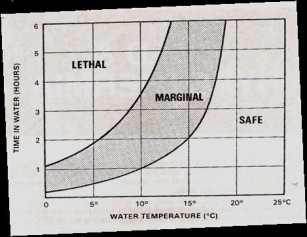
Fig. 27.2
This graph gives an indication of approximate survival times of an uninsulated human in
water of various temperatures. These figures are overestimates – a diver would be
severely incapacitated well before he reached the limits of survival. It is obvious that
survival times of less than one hour can be expected without insulation in water
temperatures found in many countries.