Basic HTML Version


Chapter 35 — 2
arrhythmia which causes sudden death is called
ventricular fibrillation,
and this usually
results in unconsciousness within a few seconds and death within a few minutes.
Severe arrhythmias tend to occur in divers who already have less severe arrhythmias, those
with cardiac ischaemia, cardiomyopathies or who take cardio-active drugs (such as for
hypertension, asthma, stimulants etc.)
Coronary Artery Disease
The heart receives its own blood supply from
the coronary arteries. Its requirement for blood
increases when it has to perform more work,
for example during exercise. For a given level
of exercise the heart has to work even harder if
the blood pressure is elevated, or if the heart
has to beat too rapidly, or if the resistance to
blood flow is increased. Arrhythmias also
increase the cardiac workload.
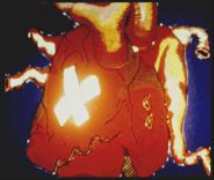
Fig.35.1
The heart is less able to cope with extra
demands for work if the coronary arteries are
obstructed, since the blood flow to the heart is
reduced. When the coronary arteries do not supply sufficient blood and oxygen to the heart
muscles, the latter becomes painful and produces central or left sided chest pain ("angina")
or breathlessness (dyspnoea). This may be temporarily remedied by reducing the exercise
and the demand for oxygen, by resting. If this deprivation of oxygen to the heart muscle is
severe enough, heart muscle dies, and this is then called a myocardial infarction ("heart
attack"). In divers, the first sign of this may be at autopsy.
Heart Muscle Disease
Some forms of heart muscle disease (cardiomyopathy – hereditary, alcoholic, or toxic) may
affect its function and can occur at all ages. A family history of early cardiac death is
especially indicative of some. In non-divers who become aware of these diseases, heart
transplants are often the only successful treatments. Divers may be unaware that they have
these diseases. Viral infections sometimes involve the heart muscle (myocarditis), often
without the patient being aware of this, and these infections predispose to cardiac deaths.