Basic HTML Version


Chapter 3 — 6
Some of the chemical constituents of the smoke are absorbed into the blood stream producing
changes in the walls of the blood vessels supplying the heart, brain and limbs. Ultimately these
become obstructed. In later life this can cause heart attacks, strokes and peripheral vascular
disease (gangrene).
CARDIOVASCULAR
SYSTEM
Blood
Arteries
take blood from the heart.
Veins
return blood to the heart. Arterial blood (which has
absorbed O
2
as it passed through the lungs), is then pumped to the periphery by the heart and is
brought close to all the cells in the body by the capillary system. Here the O
2
diffuses into the
cells and the CO
2
diffuses out of the cells into the blood.
The blood transports O
2
and CO
2
. The O
2
is mainly carried by an iron containing compound
called
haemoglobin (Hb)
contained
in the red cells. 100 ml of blood will transport
approximately 20 ml of O
2
. If the red blood cells are removed, blood plasma (the liquid part of
blood) will transport only 0.3 ml of O
2
per 100 ml blood. A drop of blood contains
approximately 300 million red cells.
In arterial blood, the haemoglobin is almost 100% oxygenated when the blood leaves the heart to
go to the tissues. It is bright red in colour. If for any reason the arterial blood is not adequately
oxygenated, it causes the blue colour of the skin and tongue (cyanosis) seen in
hypoxia
(see
Chapter 20).
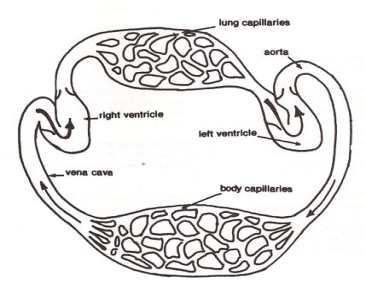
Fig. 3.3
A diagram showing the relationship between the circulations
produced by the right and left sides (ventricles) of the heart.
HEART
LUNGS
BODY