Basic HTML Version


Chapter 8 — 2
Women divers must be doing something right. Diving statistics show that females comprise
34% of trainees, but account for only 10-20% of fatalities (depending on the survey).
Scuba Training
In Western society, women are generally regarded as being less mechanically and
mathematically adept than men. This prejudice is reflected in attitudes to diver training. In
many cases, women are patronised by well-meaning male instructors and male companions.
Until recently, culturally acquired lack of assertiveness on the part of many women led them to
refrain from asking what appeared to them to be naive questions of their instructors. On the
other hand, prejudices by instructors led them to assume women would not be interested in, or
understand, the intricacies of equipment functioning or decompression planning. This
information tended to be directed towards the males in a training group. Women would often
turn to a male friend or buddy rather than the instructor for answers to questions which arose
during training. The information that they received was not always accurate.
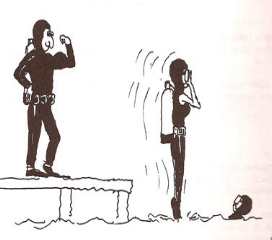
A woman who has her
equipment
assembled
and
checked by a male companion,
who has the equipment carried to
the water and who is assisted
into and out of the water, is
overall less likely to become a
competent and self sufficient
diver.
The old stereotype of the woman
in a dependent role can lead to
problems in diving practice.
Thus having men and women
buddied together for basic
training may be inappropriate.
The concept, introduced by
PADI some years ago, of an all-
women class has much to
commend it.
Fig. 8.1
Anatomical Differences
Womankind has been described as the "weaker sex." While it is generally true that on average
women are less physically strong than men, there is not a vast difference in their performance
in aquatic sports. For example, in the 1988 Olympics there was only a 10–12% difference in
times between women and men for swimming events.
For the same physical size, men on average have greater physical strength than women. This is
because men have a greater muscle mass per unit body weight. This minor difference in
strength is much less significant in the weightless aquatic environment.