Basic HTML Version


Chapter 9 — 2
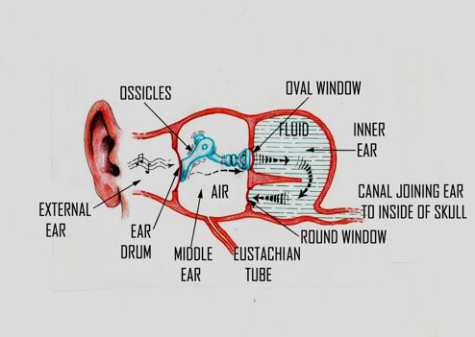
• The
Eustachian Tube
joins the middle ear with the throat, allowing air to enter the middle ear
cavity.
• The
Mastoid Sinus
(air pockets in the mastoid bone) also come off the middle ear.
There are two openings on the inner bony surface of the middle ear space called the
Round
and
Oval Windows,
because of their shape. These openings connect the middle to the inner ear. The
oval window is a tough membrane attached to the end of one of the three interconnecting middle
ear bones (ossicles), while the round window is closed by a thin delicate membrane.
The
Ear Drum (or Tympanic Membrane)
is connected by the three tiny ear bones or
ossicles
-
the malleus, incus and stapes - to the oval window across the middle ear space. This bony chain,
which is barely visible to the naked eye, transmits the sound vibrations from the ear drum to the
inner ear.
Fig. 9.2
Middle ear communicates with external and inner ear
Transmitting sound from the exterior to the inner ear
The
Inner Ear
contains the
Hearing
and
Balance organs
. It is entirely encased in bone and
filled with fluid. The hearing organ (the
Cochlea
) is a spiral shaped structure containing fluid
which surrounds nerve cells sensitive to sound vibrations.
A system of
3 semi–circular canals
is also filled with this fluid, and is the balance organ which
is sensitive to position and movement. It is also called the
Vestibular System
(or
Vestibular
Apparatus).
THE MECHANISM OF
HEARING
The hearing system works in an ingenious way. Sound vibrations, caught and reflected by the
pinna, are directed down the ear canal causing the ear drum, at the end of the ear canal, to