Basic HTML Version


Chapter 31 — 3
CAUSES OF VERTIGO
Problems arising from the vestibular system fall into two principle categories:
•
unequal vestibular stimulation and
•
unequal vestibular response.
Unequal Vestibular Stimulation
If both vestibular systems are equally sensitive but are stimulated unequally, then vertigo
may result due to the unequal responses received by the brain.
Any condition causing more cold water to enter one external ear more than the other causes
unequal
caloric
stimulation. Wax blocking one ear, an air bubble, otitis externa, exostoses,
ear plugs or a ruptured ear drum will all have this effect.
With middle
or
inner
ear barotrauma
(see Chapter 9) affecting one side, or
decompression
sickness
(see Chapter 15)
on one side, unequal vestibular stimulation may result in vertigo.
Failure of the ears to equalise pressures to the same degree can stimulate the vestibular
system unequally. This is not uncommon on ascent, as the pressure of the expanding gas in
the middle ear spaces can become greater on one side than the other due to differences in
patency of the Eustachian tubes releasing it. This is termed
Alternobaric Vertigo
or
middle
ear barotrauma of ascent
(see Chapter 9). It is very common and is often noticed as the
diver ascends a metre or so, from depth. He may even be aware of the sensation of one
Eustachian tube opening before the other, or of the expansion of air in the other middle ear.
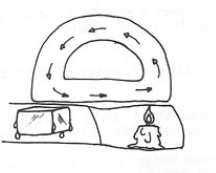
Fig. 31.3
Caloric stimulation producing "convection" current flows in inner ear fluids.