Basic HTML Version


Chapter 5 — 5
Fins (Flippers)
The use of fins considerably improves the diver's swimming efficiency. There are several designs
available.
Fins have two basic types of foot fitting — one has a shoe integrated with the fin (enclosed heel), and
the other has a half shoe fitting and a heel strap (open heels) which allows the diver to wear neoprene
boots. These boots can be used for protection when walking over reefs, and offer some thermal
insulation to the feet.
The blades of the fins vary in size and rigidity and some types are fitted with vents (for a venturi
effect). Studies of various fin types have shown that no one type is ideal for all divers. Fins with
larger, more rigid blades, allow a more powerful action but require greater strength and are more
difficult to manoeuvre. Muscular cramps can result from inappropriate powerful fins. In general, fins
of medium size and medium flexibility are suitable for most recreational divers.
The way fins are used is important. Traditionally, a narrow, straight-leg kicking stroke has been
taught. A less graceful wide-kicking stroke using bent knees is more efficient. This comes from
directing the thrust of the fin along the direction of movement of the diver. Beginners may need
coaching to avoid a bicycle peddling action, which is ineffective as a swimming stroke.
Fins with integrated shoes can often cause
blistering and abrasions ("fin ulcers") on the
foot or ankle, around the rim of the shoe fitting.
This can be reduced by the use of socks until the
diver becomes more accustomed to the
particular fins. Correct fitting of the fins is
necessary. If too loose, their loss will endanger
the diver. An excessively tight fit may cause
muscular cramps and fin ulcers.
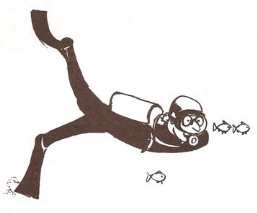
New divers tend to rely on hand movements for
propulsion. This is not effective underwater and
they have to learn to employ fin propulsion
Fig. 5.5
Wet Suit
The wet suit provides protection, comfort and safety. It is made from rubber or neoprene which
incorporates tiny air bubbles, to provide good thermal insulation. It also provides protection from
scratching, abrasions and stinging animals.
On the surface and in shallow water, these suits give great buoyancy. To overcome this effect and
therefore submerge, accessory weights are usually necessary. At depth however, the air bubbles in
the wet suit are compressed (remember Boyles Law?), reducing its thickness, buoyancy and
insulating properties. The variations in buoyancy at different depths may need to be offset by the use
of a buoyancy compensator.