Basic HTML Version


Chapter 5 — 6
A poorly fitting wet suit can
cause chafing, especially around
the neck and arm-pit. A wet suit
with an excessively tight neck
can also compress the blood
vessels to the brain leading to
dizziness and fainting. Tightness
around the chest may cause
difficulty in breathing. Zippers
allow for easier access and exit,
but contribute to water leakage
and reduced thermal reliability.
Fig.5.6
A wet suit variant containing
inflatable gas compartments can
partly overcome these problems.
These suits can be inflated orally
or directly from a scuba tank. Careful venting on ascent is necessary in order to prevent too rapid an
ascent with these suits as the gases expand. They are a modern version of the traditional "
dry suit
".
The latter is used in colder waters, when a layer of gas is injected between the rubberised suit and an
insulating undergarment. A gas cylinder adds air into this space during descent, and the air is
exhausted during ascent, to maintain neutral buoyancy. Because of the added buoyancy problems,
special training is needed to use dry suits. See Chapter 12 for suit “blow up”. Urinating in dry suits is
problemmatic, and the P-Valves that permit urinating into the ocean can cause rare but serious
problems with retrograde flow of sea water, air and infections into the genito-urinary tract
There are
hybrid suits
that include characteristics of both wet and dry suits, and some include fluids
and malleable solids that replace the gas spaces and avoid the variable buoyancy effects with depth.
Weight Belt
A weight belt is used to offset the buoyancy of the body, wet suit and other items of equipment.
Ideally the diver should use enough weight to produce neutral buoyancy at the surface (without
reliance on a buoyancy vest) or at a shallow depth, about 3-5 metres – where a safety stop is often
indicated. The correct amount of weight is found by trial and error and this should be done in shallow
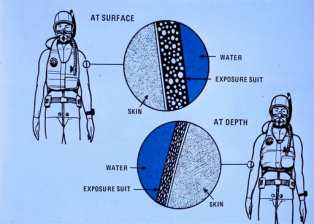
water. As the diver descends, compression of the wet suit makes the diver less buoyant. This effect
can be offset by the use of a buoyancy compensating vest (B.C.).
A diver without a wet suit will usually require less than
2 kg (5 lbs) weight and many divers will require no
weight at all. A diver wearing a wet suit may require
about 1 kg weight for each 1 mm wet suit thickness,
with an extra 1 kg for neoprene booties or hood.
Inexperienced divers tend to use more weights than
experienced divers, and are therefore more at risk from
buoyancy problems.
Fig. 5.7
The deliberate attachment of up to 10 kg of lead
weight, or more, to an otherwise neutrally buoyant air-
breathing creature in the water has obvious safety
consequences. It aids in descent, but may impair the