Basic HTML Version


Chapter 1 —
3
The development of
self-contained
air supplies was
impeded by the lack of sufficiently powerful
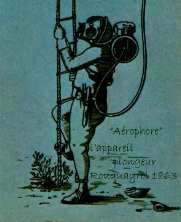
compressors and reservoirs. In 1863 the Frenchmen,
Rouquayrol and Denayrouze, invented the first
satisfactory demand regulator for self-contained
underwater breathing apparatus (SCUBA), but due to
lack of suitable high pressure air compressors and
cylinders, it was limited to surface air supply lines.
In 1878 H. A. Fleuss made a workable self-
contained
(closed-circuit)
oxygen
breathing
apparatus utilising caustic potash to remove exhaled
carbon dioxide. "Closed" refers to the absence of an
outlet for gas (i.e. no bubbles) and means that the
exhaled gas is rebreathed. This was the forerunner of
modern closed-circuit diving units.
Fig 1.4
Rouquayrol and Denayrouze, Diving suit 1863
Divers in the late 1800's were capable of reaching depths in excess of 50 metres, but the effects
of decompression sickness (or bends) caused much concern and many injuries to divers. Paul
Bert, a French scientist, was the first to explain that the disease was caused by the formation of
nitrogen bubbles in the body and proposed the idea of a slow ascent to the surface. It was not
until the early 20th century that Dr J. S. Haldane derived satisfactory mathematical
decompression tables to overcome this physiological problem of deep diving. The first
successful tables were based on the assumption that decompression sickness could be avoided
by not exceeding a 2:1 pressure reduction between stops. It reflected a mathematical model of
inert gas behaviour in a body and was to be the forerunner of current decompression tables.
Later observations showed this principle to be incorrect in many cases, but these early tables
and the later modified versions, prevented many divers from developing the bends.
Diving research this century has lead to a great improvement in all forms of diving equipment
and since 1940 the use of such equipment has increased greatly. The design by Cousteau and
Gagnan in 1943, of a proper demand-regulated air supply from compressed air cylinders worn
on the back has developed into modern day
scuba
.
The scuba equipment used today, with the high-pressure regulator on the cylinder and a single
hose to a demand valve in the mouth, was invented in Australia and marketed by an engineer
named Ted Eldred in the early 1950s, under the
Porpoise
trademark.
Closed-circuit rebreathing
apparatus using, oxygen or oxygen/nitrogen mixtures, has also
been improved considerably since the early units used by Italian Naval divers in their attacks on
shipping in Gibraltar in 1941. With the advent of deeper diving, gas economy has become a
major problem and for this reason closed-circuit systems have achieved even greater
importance.
Diving to depths in excess of 100 metres required not only the development of specialised
closed or semi-closed circuit rebreathing apparatus, but also the use of other inert gas mixtures
mixed with oxygen. Nitrogen, because of its narcotic effect at depth, has been replaced largely
by other gases such as helium and hydrogen. These are not used without complications – as all
gases cause specific physiological problems and no ideal mixture yet exists.