Basic HTML Version


Chapter 1 —
2
early "schnorkel". Its use was limited to very shallow dives, since man's respiratory muscles
cannot draw air very far down from the surface – maximum half a metre. It was also depth
limited due to the excessive volume of the breathing tube.
Leonardo da Vinci sketched several designs for diving equipment and submarines. Many
diagrams of divers' hoods can be found in other historical texts from 1500 AD onwards, but
much of this equipment would not have worked at
depths greater than a few feet. They did, however,
attest to man's desire to remain below the surface
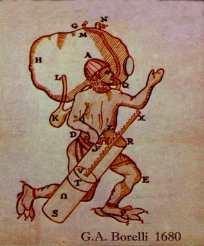
for extended periods. In 1680 Borelli, an Italian,
designed a diving set which purported to be a self-
contained diving apparatus. Although it was
impracticable, the idea was revolutionary at that
time. Despite the fact that much diving equipment
was primitive and rarely functioned adequately,
diving bells were used with success from the 17th
century onwards.
Fig. 1.2
Diving with a helmet (the equivalent of an upturned bucket which enclosed the diver's head)
gradually became an accepted method. It contained air that was pumped down from the surface
following the development of efficient air pumps around 1800 AD. Bellows were used to force
air down to the divers. This allowed longer and deeper dives and brought to light the many
physiological problems caused by the undersea environment.
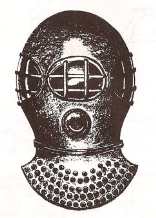
In 1837 Augustus Siebe marketed the first effective standard
diving dress. This incorporated an air-supply line connecting
a pump or compressor on the surface to a diving helmet. The
helmet was attached by an airtight seal to a flexible suit that
enclosed the diver and was filled with air.
Fig. 1.3
Siebe's helmet.